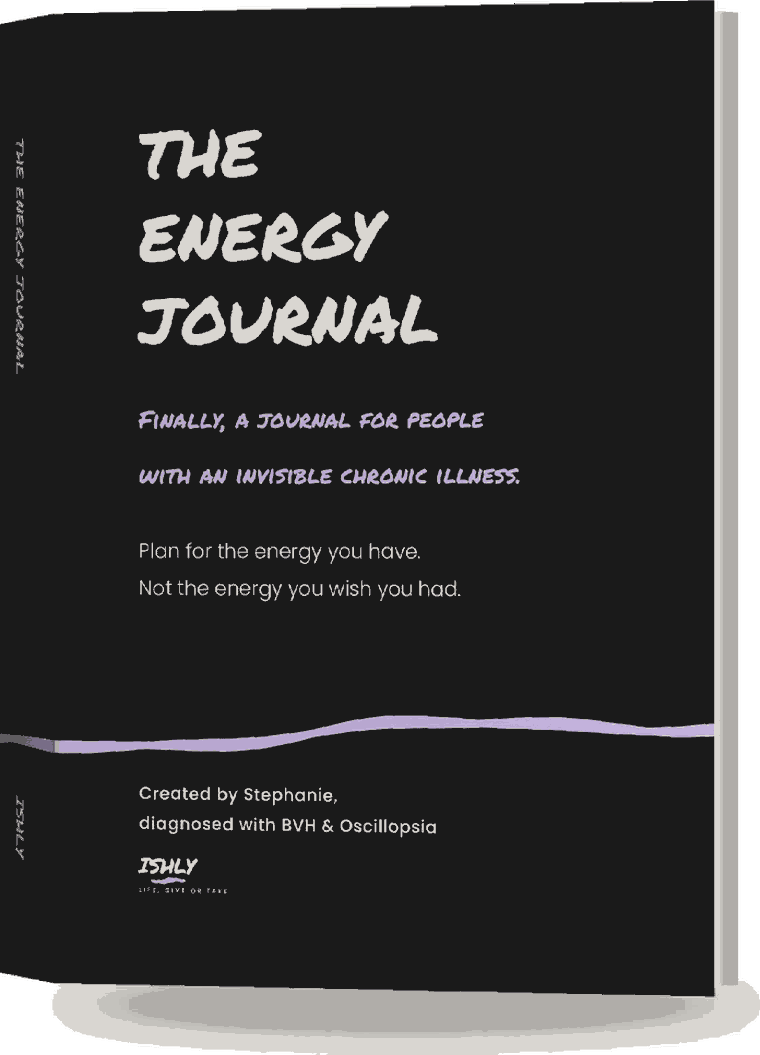
THE ENERGY JOURNAL

Your energy is limited. Stop wasting it trying to keep up.

For people living with chronic illness, fatigue and energy that changes by the hour. Twelve undated weeks, built around the energy you actually have, not the energy you are supposed to have.

Buying it for someone else? Start here.

12weeks of pages to fill in, or not
0dates printed anywhere in it
0streaks to break, or restart
4energy levels, named in your own words

WHY THIS ONE EXISTS

Most journals are designed to help you do more.

-ish what the planner assumed you had what actually turned up today

This one is designed to help you live better with the energy you actually have. Spot your patterns, understand your limits, make better decisions, and stop feeling guilty about what did not get done.

Writing things down is one of the few pieces of wellbeing advice that holds up when somebody actually studies it. So you buy a journal, and it turns out to have been written for a different body, a different mind and a different twenty-four hours than the ones you have.

Five a.m. starts. Habit trackers. Three goals before breakfast. A gratitude page on a day you could barely stand up in. None of it is badly made. It is made for somebody whose energy turns up when they ask it to.

Journaling did not fail you. You were handed the wrong journal.

The same Tuesday, written up twice.

In an ordinary journal

  • 5:30 startmissed
  • Habit streakbroken, back to day 0
  • Three goalsone of three
  • Steps1,140
  • Three things I am grateful forleft blank

A wasted day.

In The Energy Journal

  • Capacity todaylow, and I knew by ten
  • I spent it onthe hospital call, and the form
  • What that costthe whole afternoon
  • I stopped before I had toyes
  • Worth ityes

A day handled well.

Same Tuesday. Same body. Only one of those pages is telling you the truth about it.

Some days the honest entry is that you gave in and went back to bed, and in here that is a finished page rather than a gap. Because being quietly proud of a day you got through on almost nothing is a real feeling, and until now there was nowhere to write it down.

Twelve weeks of the page on the right.

Buy it on Amazon

WHAT MAKES IT DIFFERENT

Not another journal telling you to try harder.

One that starts with a simple question every morning: how much do you actually have today?

empty-ish low-ish okay-ish good-ish today: low-ish. plan accordingly.

Four levels, named in your own words. You check in first, then decide what today needs.

  1. Plan around the energy you have

    Not the energy you wish you had. Look at what is actually in the tank, then decide what today needs. A small change that saves whole afternoons.

  2. See your own patterns

    Learn what drains you and what helps. A few weeks in, it is simply there on the page. No graphs to build, no app to keep up with, no turning yourself into a data project.

  3. Say no without the guilt

    There is a line for what you are letting go of today. Written down, it becomes a decision about your energy instead of one more thing you failed at.

  4. Count the days you got through

    Even when getting through was the whole achievement. In here that is a finished page, not a gap, and being quietly proud of it is the point.

  5. Stop, skip, come back

    Twelve undated weeks and absolutely no catching up. Put it down for a month and nothing is waiting to tell you what you missed.

LOOK INSIDE

A quick look inside.

Four of the spreads, not the whole thing. Nothing in here needs a good day to fill in — two minutes in the morning, two at night, and the rest of the page leaves you alone.
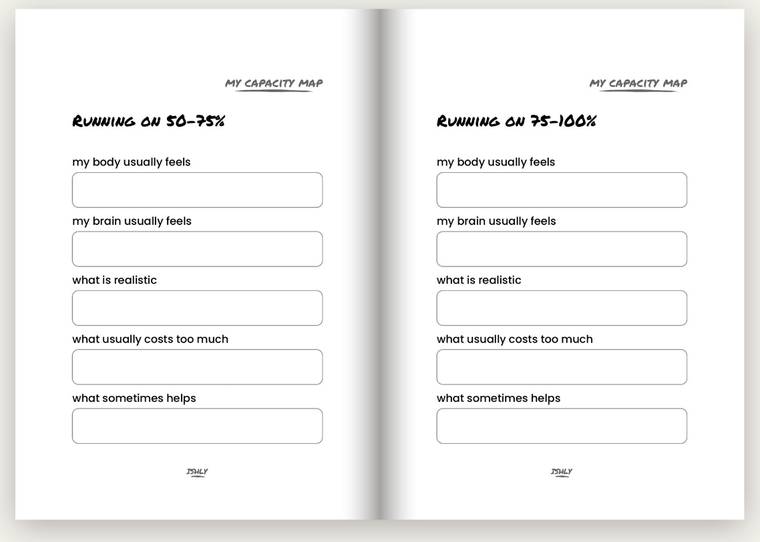
The Energy Journal — my capacity map
My capacity mapFour levels, named in your own words, so that “a bad day” finally means something you can plan around.
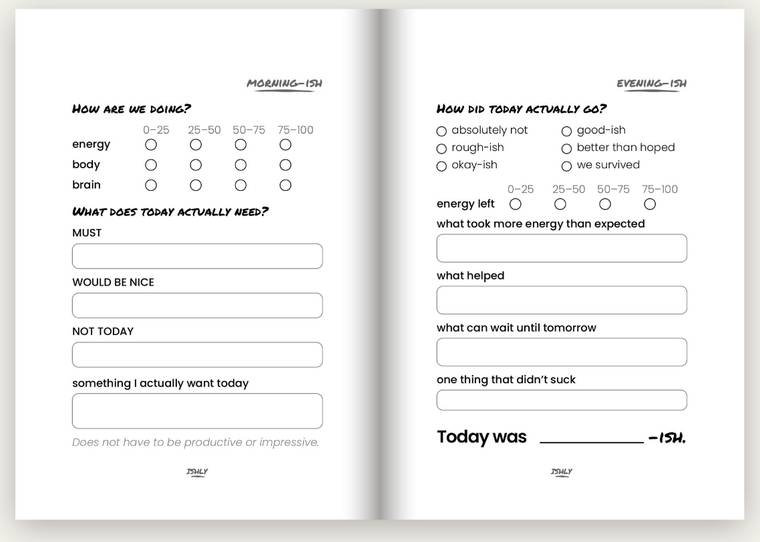
The Energy Journal — morning-ish, evening-ish
Morning-ish, evening-ishThree circles before you start, four lines when you stop. Two minutes a day, and that is the whole ask.
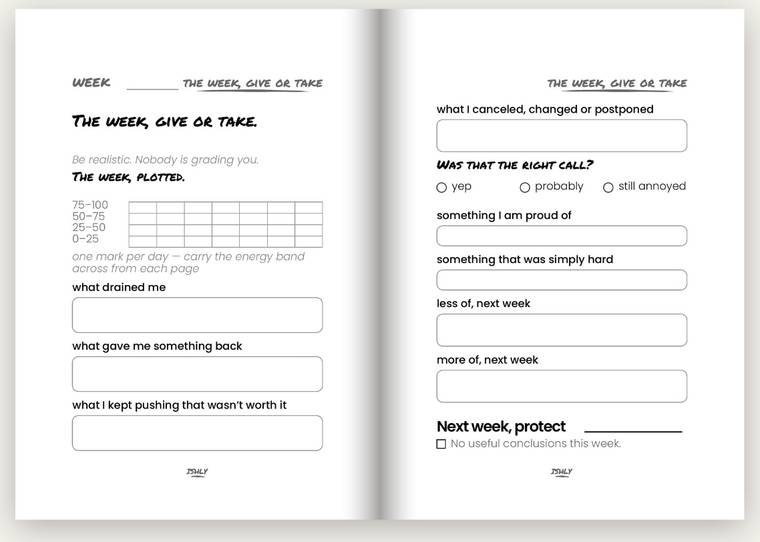
The Energy Journal — the week, give or take
The week, give or takeOne mark a day. After a fortnight the pattern is simply there, without you turning yourself into a spreadsheet.
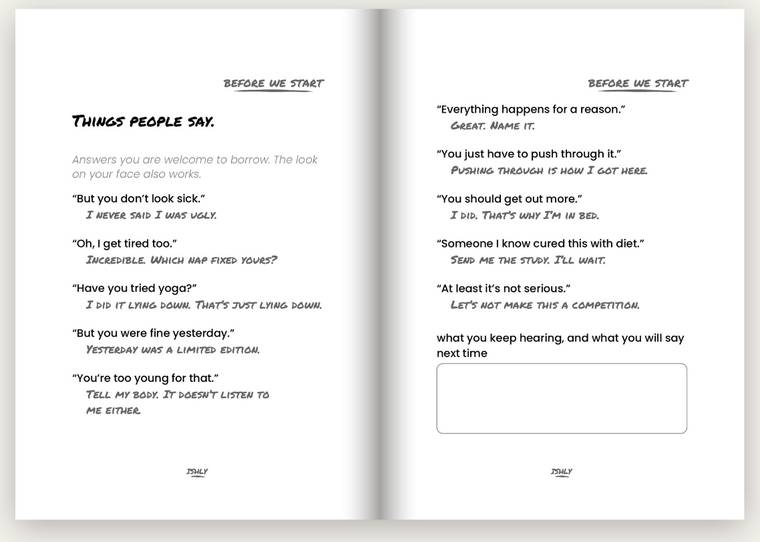
The Energy Journal — things people say
Things people sayA page of replies, ready for the next time somebody tells you that you do not look sick.
swipe

Two minutes a day. That is the whole ask.

Buy it on Amazon

FOR EXAMPLE

Answers you are welcome to borrow.

There is a whole page of these in the journal, for the next time somebody means well. Here are four, on the house.

“But you don’t look sick.”

I never said I was ugly.

“Have you tried yoga?”

I did it lying down. That’s just lying down.

“But you were fine yesterday.”

Yesterday was a limited edition.

“You just have to push through it.”

Pushing through is how I got here.

AND WHAT IT WILL NOT DO

No morning routines. No habit streaks. No forced gratitude.

Just a practical, refreshingly honest way to get through everyday life when your body does not always cooperate. Everything that usually makes a journal feel like homework has been taken out.

Nothing in it to fall behind on.

Buy The Energy Journal

Things this journal will never ask of you

  • No 5 a.m. startsNo morning routine you have to earn the right to follow.
  • No Habit streaksA bad fortnight is not a failure of discipline.
  • No Forced gratitudeBeing told to list three good things on a bad day is its own small insult.
  • No Dated pagesThree weeks off does not leave a trail of blank pages behind you.
  • No Symptom scoringNothing in here is for somebody else to read. This one is yours.

GIVING IT TO SOMEONE

A gift that does not ask them to get better.

Most gifts for someone who is ill accidentally say try harder, or here is a productivity system for your body, or worse, get well soon.

This one asks nothing of them. It does not need a good day to be opened, it does not keep score, and it will not make them feel behind if it sits on the bedside table for a month.

Buy it as a gift

It ships from Amazon, so it can go straight to their address.

for the card, if you want it

No pressure to use it. I just liked that somebody finally made one of these.

For a partner, a friend, a sister, or the colleague who stopped explaining herself.

BEFORE YOU ASK

The sensible questions.

Something I have not covered? Write to [email protected] and ask away.

Buy it on Amazon
Do I need a diagnosis to use it?

No. If your body does not reliably cooperate, it was written for you. Plenty of people are years from a name for it, or will never get one, and none of the pages ask.

What happens if I skip a week? Or a month?

Nothing. There are no dates and no streaks, so you pick it up where you left it. The skipping is designed in rather than tolerated.

Is this a symptom tracker for my doctor?

No. It records capacity and cost rather than symptoms, and it is written to be useful to you rather than legible to somebody else. Take anything you like to an appointment, but that is not what it is for.

How long does twelve weeks actually last?

Longer than twelve weeks, in practice. It is undated, so it lasts as long as you use it — three months of solid use, or a year of dipping in.

Paperback or hardback?

Both, and you choose on the same Amazon page. Hardback if it is going to live on a bedside table for a year, paperback if it is going in a bag. What is printed inside is identical.

How is it made and sent?

Printed on demand once you order, then posted to you by Amazon in your own country. Printing on demand means nothing sits in a warehouse and nothing gets pulped.

What if I open it and it is not for me?

Then it is not for you, and that is a perfectly good outcome. Write to [email protected] and I will sort it out.

Stephanie, founder of ISHLY, sitting on a low wall and laughing.
Stephanie-ish. Founder of ISHLY.
She needed it first.

WHO MADE IT

Created by someone who gets it.

ISHLY founder Stephanie spent two and a half years searching for answers before being diagnosed with bilateral vestibular hypofunction and oscillopsia.

She knows what it is like to wake up without knowing how much energy you will have, to cancel plans, to push through when you should not, and to feel frustrated when your body refuses to keep up with your ambitions.

After realising that traditional planners and journals only added more pressure, she made the journal she wished had existed.

A day spent resting is not a wasted day.

This is a way to stop measuring your days by how much you achieved, and start recognising how well you managed the energy you had. You deserve a journal that knows the difference.

Out now, in every Amazon store.